

Eye Tracking
Eye tracking shows where attention goes when someone looks at a visual — an ad, a pack, a shelf, a social post. Elaiia simulates it with computer vision: the model predicts which parts of an image draw the eye, and reports the result as a heatmap.
An eye-tracking question looks like this:
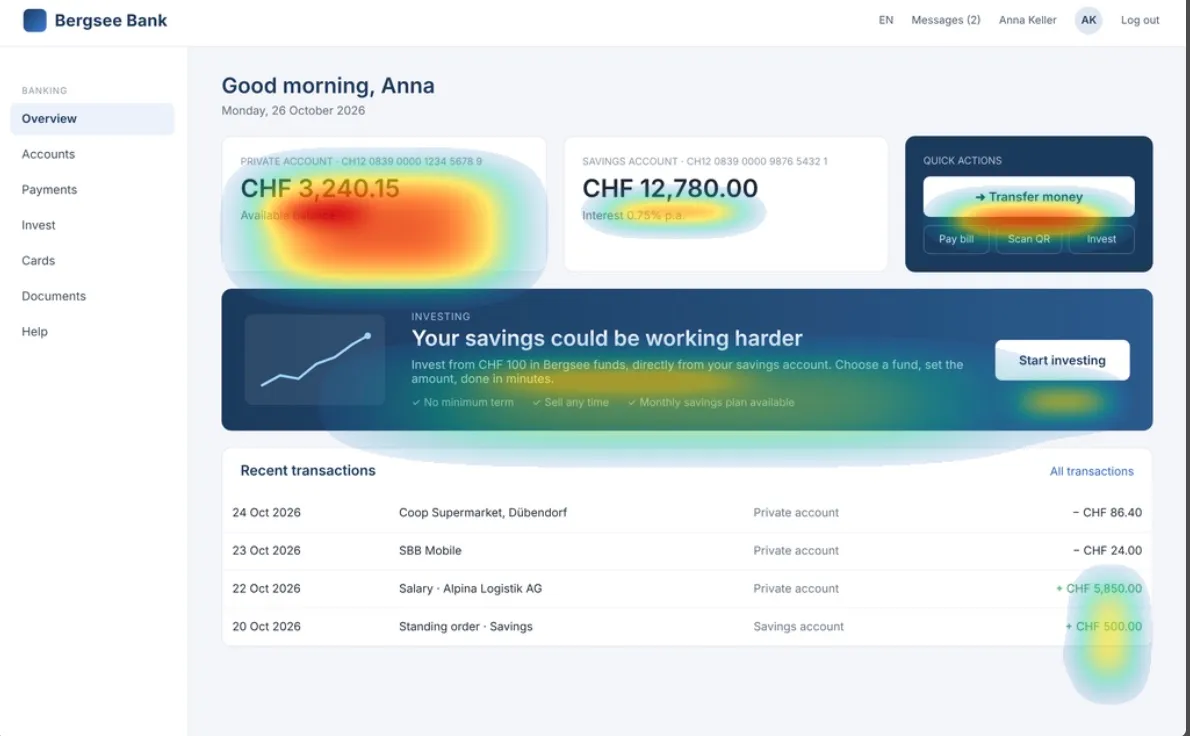
Two measures you’ll see in the report
Section titled “Two measures you’ll see in the report”- AOI (Area of Interest) — a region of the image you want to know about, such as the logo, the product, a headline or a face. Results are reported per AOI.
- Hit ratio — the share of twins whose attention lands on an AOI. A logo with a hit ratio of 30% was noticed by fewer than a third of the sample.
Eye tracking vs. asking for opinions
Section titled “Eye tracking vs. asking for opinions”Eye tracking and perceptual or attitudinal questions — appeal, understanding, brand fit, purchase intent — measure different things, and their results mean different things.
| Eye tracking | Perceptual / attitudinal questions | |
|---|---|---|
| Measures | What gets seen | What people think and feel |
| Answers | “Is the logo noticed?” | “Do people like the ad? Do they get the message?” |
| Doesn’t tell you | Whether what’s seen is liked or understood | Whether people noticed the element at all |
High attention isn’t the same as liking: a face can pull every eye and still say nothing about the brand. And a strong claim does nothing if no one sees it.
Using them together
Section titled “Using them together”Ask both about the same visual, and read the results side by side:
- Seen and liked — the element works.
- Seen but not liked — the visibility is there; the message or execution needs work.
- Liked when shown, but not seen — a visibility problem. Make it bigger, move it, or remove what’s competing with it.
- Neither — rethink the element.
When to use eye tracking — and when a concept test
Section titled “When to use eye tracking — and when a concept test”Use eye tracking when:
- You need to know whether key elements — brand, product, price, claim, call to action — get noticed.
- The visual is seen in passing: a shelf, a billboard, a feed someone is scrolling through.
- You’re comparing layouts or creative versions for visibility. Combine it with a parallel design to test each version on its own.
- You suspect something is stealing attention from the product.
Use a normal concept test when:
- You’re testing the idea itself — appeal, relevance, uniqueness, purchase intent.
- The concept is mostly text, or there’s no finished visual yet.
- You want to know why people react as they do, or whether they understand the message.
Most visual tests benefit from both: eye tracking for what gets seen, a concept test for what it means to people.